The role of the product designer is evolving fast. Faster than you can say, “fastnacht”.
Thanks to AI, parts of the work that used to define a designer’s role are being automated away, leaving many designers confused and lost. Early-career designers, in particular, are facing growing uncertainty. Landing a job in UX or product design nowadays feels almost impossible, like chasing rainbows.
In this new era, I’ve been working AI into every stage of the design process while the devs dive headfirst into “vibe coding.” And there it was again—that old, familiar feeling: “I have no idea what I’m doing.” But instead of having a typical Joyce-meltdown, I leaned in. For me, re-living that “oh no, not this again” feeling of being lost has become a signal, forcing me to re-evaluate where I am and ultimately re-define my process.
In other words, it’s time to sort the chaos.
Sort the chaos. I’ve written about this before in my work on discovery research. It’s the same anxious, disoriented feeling I get at the start of any new project: I’m in unfamiliar territory, surrounded by tons of information but without a clear path. I don’t yet understand the data or the space, the details are overwhelming, and I have to navigate ambiguity, until things begin to make sense.
I’m experiencing that same feeling while working with AI outputs. But this time, sorting the chaos is a little different. My day-to-day used to be understanding humans, but is now focused on making sense of what AI produces. Instead of finding meaning in user research, I’m decoding AI outputs: unpacking my dev team’s vibe-coded prototypes, shaping them into coherent flows, and filling in the gaps. It’s less about discovery and more about translation and structure.
This process feels backwards and illogical. The exact opposite of everything I know. It’s like designing in a world where the usual rules no longer apply, much like the Bizarro Superman World:
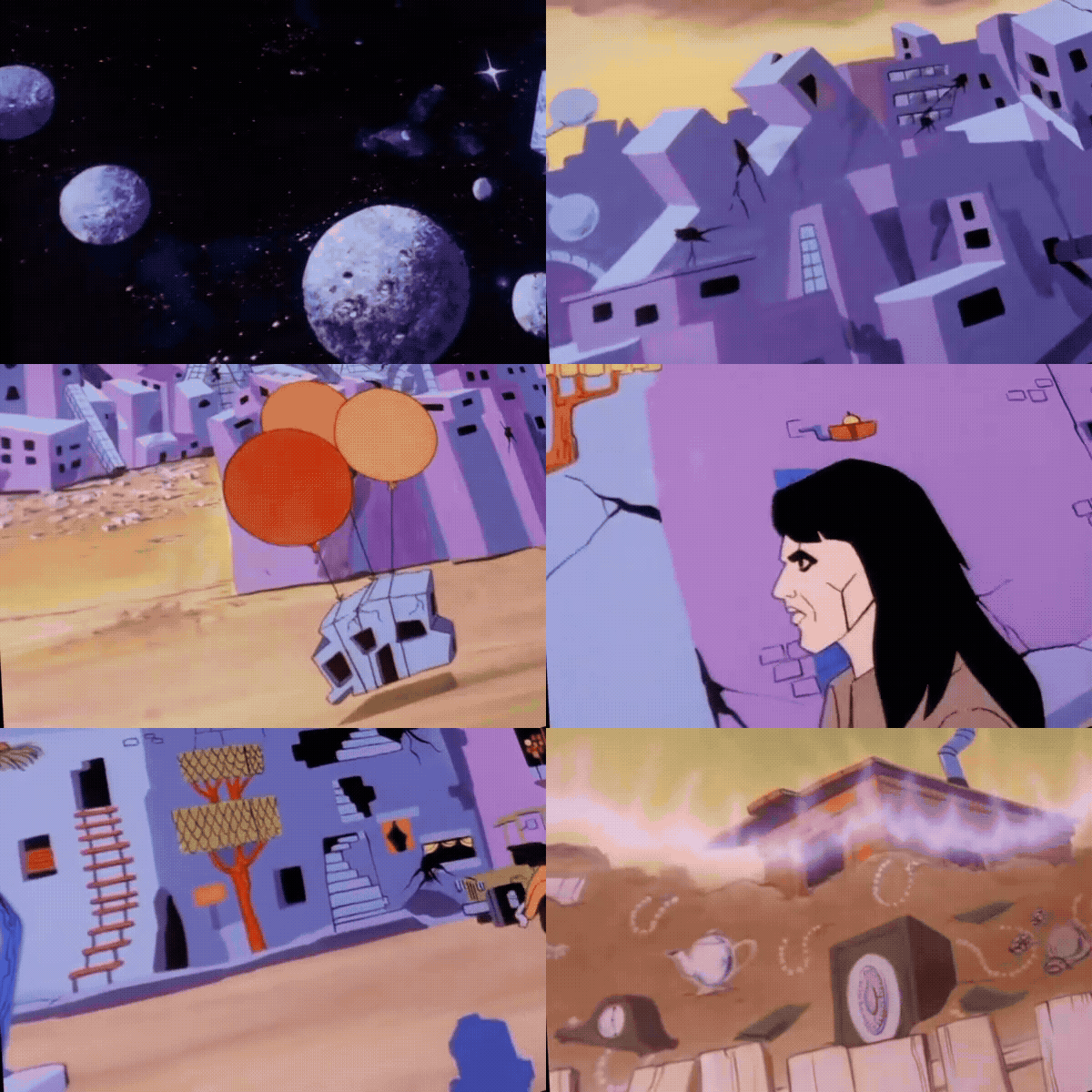
This world, this home to Superman’s opposite is where everything is backwards: up is down, down is up, he says ‘hello’ when he leaves, ‘goodbye’ when he arrives.
This am not make sense.
In my Bizarro World, I’m not only finding my way through the process, but I’m also redefining my role as a designer within a team, and within the organization itself.

I’ve worked across a range of organizations throughout my career, and I’ve contributed to every phase of the product lifecycle. I’ve built products from scratch, jumped into projects midway, and even revived past failures and guided each one across the finish line to launch.
I’ve become comfortable with the chaotic messiness of the design process: the ambiguity, the iteration, and the constant refinement it demands. My extensive familiarity with the phases and demands of the design process is what enables me to navigate this new BizzAIro-driven world and turn its outputs into clear direction.
At its core, design is about making sense of the stuff that doesn’t make sense. Design brings context to a project. Design finds meaning in the gaps. I gave a talk about this recently at MBZUAI: design is about noticing what isn’t said and making sense of the gaps between signals.
And these gaps aren’t new. What’s new is where they show up. They now exist in AI-generated outputs, and it’s our job as designers to make sense of them.
It’s time to sort the chaos. Again.
In the end, the work hasn’t become less messy—it has just changed shape. The chaos is still there, whether it’s in fragmented user signals, or a flood of AI-generated outputs, or both. What matters is how we move through it.
And this may be where early career designers struggle. Having little (or no) experience in the design process before the Bizarro-Intelligence-World, it can be hard to know where to start, or even what exactly needs sorting.
Sorting the chaos isn’t about knowing the answer from the start. It’s about putting your messy process on display, making it visible, logical, and understandable to the people around you. Show your work early and often. I talk about this frequently. It builds trust and gets early buy-in.
The artifacts we share may look different now. Instead of messy Figma files, rough whiteboard sketches, or multi-tab spreadsheets (you know I love a good spreadsheet!), it also includes evolving AI prompts, interpreted outputs, and the decisions they inform. With these tools, we can surface patterns, test directions, and make our thinking clear, to create alignment early, build trust, and turn chaos into clarity.
Navigating the flood of AI outputs becomes a team-shared starting point rather than a private struggle. And in this shared space, my role as the designer evolves, from delivering data-informed design solutions (I still do this) to helping teams make sense of complexity together.
Because ultimately, the role of the designer isn’t to eliminate the chaos. It’s to navigate it—clearly, collaboratively, and in a way that others can follow.
It’s a different world. Bizarro Superman would say: